Showing posts with label guitar. Show all posts

Sunday, September 29, 2024

My First Day with Steve Harris

Steve Harris was the lead guitarist, songwriter, driving force and one constant presence behind English melodic rockers SHY, from their inception in 1983, until his devastating and untimely death in 2011 at the age of just 46. Steve was a unique person; he was an ego-free dominant introvert who just happened to be a genius as well. And that's before you get to his unbelievable talent as a musician, songwriter, band leader and all-round good person. 

I had met Steve a couple of times in 1989 and 1990, as I had all of the band members. Most of the others could be found in the venue bar within minutes of the show finishing, but a rendezvous with Steve always required blagging my way backstage or hanging around in the parking lot until all the other punters had left. 

One such meeting took place in the dressing room at London's Astoria after Shy had played what turned out to be their last UK show with Tony at the mic for a very long time. But that was all in the future as I talked to Steve about the band's imminent US tour and gave him my views on "Broken Heart" which had just been released as the third single from the "Misspent Youth" album. Steve and the other guys were good enough to sign my seven-inch copy of "Money" and one or two other things, and someone in the band even gave me a can of Kaltenberg Pills!

In the years before the interwebs, there were only two ways to keep up with news on your favorite bands: there was Kerrang! magazine and there was word of mouth. And news of Shy was thin on the ground in both of these arenas throughout the next two years. I did learn that Tony had departed and the band had tried out a lot of different singers, but it was not until the Autumn of 1992 that I heard on the grapevine that the band was alive and well with a new singer intact, albeit operating under the name "Crazy-Crazy." My response to this information was to wave my magic wand and get myself an audition to be Steve's new guitar tech. I've always believed in my power to will certain things to happen if I wanted them badly enough; it hasn't always worked, but this was one of the times when it did. 

So, at least two years after my last meeting with anyone in the band, I found myself at Digbeth coach station on a very dull and cold October afternoon where Roy had said he would pick me up. I couldn't see him anywhere in the main part of the bus station when I arrived, or outside on the street, so I found a seat in the waiting room. I sat and wondered if I would recognize one of the country's least famous but most entertaining and quick-witted bass players without his Jack Daniels t-shirt? For the first few minutes I was on high alert, scanning the waiting room door, the window on the opposite side and the rest of the room on rotation, for any sign of Roy. Eventually I relaxed and my mind drifted off to who knows where.

My daydreaming was curtailed by a gentle enquiry: "Are you Papa Sheep?" I glanced upwards, and there was not Roy, but Steve, half leaning/half bending down towards me, smiling and with his hand outstretched. I jumped to attention, uttered brief confirmation of my identity, shook his hand and started trying to pick up my bags all at the same time. I had a large duffle bag, a small rucksack with my sleeping bag hanging out of it and the ubiquitous silver-colored camera suitcase that loads of "music people" carried at the time, and, for all I know, still do. Steve picked up my duffle bag and the suitcase and led the way outside. It felt weird watching him carry my stuff, since I was essentially there to do that for him. 

Outside Roy was waiting in his black Ford Escort that I'm pretty sure was parked illegally. Steve put my duffle bag onto the back seat and pushed it over to the other side, then he climbed in and put my case on his lap. That just left the front seat, so I got in next to Roy and we drove off towards the band's rehearsal space. This was a journey of about 3/4 of a mile, that I would make many times over the next couple of years, mostly on foot. In the car it could typically be accomplished in less than five minutes, but on this occasion, it took closer to half an hour - Roy said that Princess Anne was visiting Birmingham that day and traffic was screwed up everywhere. He also made the memorable comment that "This place gets more like America every day" which was not intended as a positive. Roy was wearing what looked like jogging bottoms over the top of another pair of trousers, and a thick sweater. He looked at my T-shirt and thin jacket and warned me it was going to be cold at the rehearsal space. 

Eventually Roy pulled into the carpark in front of a decades old industrial building that was probably marked for demolition at the time - it's a multistory carpark now in fact. The rehearsal room was on the ground floor, and it was there that we found Paddy tinkling on the keyboards and Alan sitting on the floor trying to solder something inside a tom-tom shell. There was no sign of new singer Wardi. After a brief introduction I asked Alan if he needed any help. He didn't. I decided not to mention that his work looked like a dry joint and turned my attention to the band's equipment. The room was rectangular, and all the gear was setup along one of the long walls, facing outwards, just like it would be on stage: drums were in the middle, Steve at stage left and Roy and Paddy sharing stage right. Steve's guitar rig had a very impressive array of components:

The guitar case at the left was used for the white sharks fin

The reason for my presence on that October afternoon was simple: day #1....learn the band's gear; day #2....band's first gig in Birmingham with Wardi where I would be the only tech. There had been a few shows with Wardi before this including Bobby Brown's in Nottingham, the legendary White Knights Festival in Russia and an appearance at Lakeside Thurrock to mention just a few, but the gig at Tramps was an important occasion in the development of the new line up. And I was off-the-scale excited to be a small part of it.

Roy gave me a tour of the rest of the building, which could be a blog post in its own right, and then showed me his bass setup. It was pretty simple. I talked "guitar stuff" with Steve for a few minutes. He seemed very laid back and not at all possessive of his equipment, which was not what I was used to. Later we took a short walk outside and Steve showed me the nearest newsagents and the place where the band went to get takeaway bacon sandwiches, cups of tea and so on.

When we got back it became apparent that there would be a few hours to kill before Wardi's arrival. This was the signal for the other three guys to adjourn to the pub (what was then The Australian Bar on Hurst Street at Bromsgrove if you're interested). Steve didn't want to go to the pub which I thought was odd, but then I didn't know him at all at that point. I can't remember if I was invited to the pub or not, but it didn't matter because I had no intention of going. Not when I had the opportunity to hangout one-on-one with Steve Harris. 

I started off professionally enough, and we talked technical stuff for a bit. I don't think I'm giving anything significant away when I say that Steve played very light strings, 0.08 to 0.38, known as "eights." Steve and Roy down tuned a full step in the live arena which made for a very "slack" feel to the strings on both instruments. Steve chose all of his Fernandes guitars from pictures in various catalogues; they actually had quite wide necks which, he claimed, were difficult to play with his "small fingers."

That was about all I could manage before I lurched into full-on fanboy mode and started peppering him with questions about the band and their history. If I had known Steve better, I probably would not have asked most of the questions I put to him, but I was pretty young, and he was good mannered enough to respond to everything. What was a private conversation will remain so, but what I will say is that Steve was amazingly forthcoming and nothing Shy-related was off limits.

The thing I noticed right away was that whatever Steve had to say about other people was always positive. He liked everybody! After I got to know him better, I figured he would have probably been happier practicing his guitar rather than being grilled by the hired help, but of course he was too polite to say so. Steve was the member of the band, I would learn, that always had time to answer fans questions and never used it as an opportunity to show off. If anything, he was embarrassed by attention from fans. As I would also learn, when there was some waiting around to be done - and there was plenty - Steve would rather hang with the road crew than go to the pub or go wherever the rest of the band was going. That was one of the reasons I got to know him so much better that the other guys in the band. The other reason was because of who he was which was funny, entertaining company, the type of person you would always choose to spend time with if you could.

It was pretty late when the other guys returned, and this was when I was introduced to Wardi for the first time. It was also the moment everyone else had been waiting for all day: rehearsal time. What followed, from the band's point of view, was a professional run through of their set the day/night before the gig. From where I was sitting, which was facing the band, it was a concert for one. I knew to expect some new songs, but I was also thrilled by the inclusion of several Shy classics despite this being the brief "Crazy-Crazy" era. I have to say, it sounded great, and it was great. Nothing in music compares to watching the guitar solo in "Reflections" being played a couple of feet away just for you.

It was very late when the rehearsal finished. Not long after that I was fast asleep next to the PA stack. The next day's show went ok I think; maybe I'll write about that one day. When I called Steve a few days later to ask him if I got the gig he replied with a question: "What did Roy say?"

Tuesday, November 23, 2021

Guitars part three

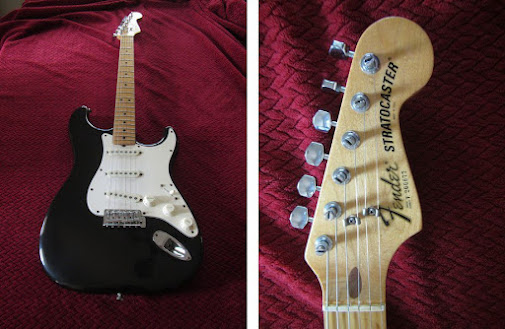
More guitars? Really? Well, yes, just one more. For now, anyway. I wrote in part two about how I spent a while looking for the perfect Stratocaster, and ended up with a '52 Telecaster reissue instead. The Tele is a beautiful guitar that has seen a lot of playing time over the last few years, but I have still been on the lookout for the right Stratocaster. My dream guitar would have been David Gilmour's legendary Black Strat, but I was outbid by just under USD 3,975,000 when it came up for sale in 2019. The Fender Custom Shop made replicas of this guitar which even included the wear marks, but even these instruments are outside of my price bracket. Fortunately a resolution presented itself...

(14) Fender Stratocaster 1982

The solution was the 1982 Tuxedo Black Stratocaster I found online in September this year. After Leo Fender sold his company to CBS in 1965, there was a gradual decline in the quality of guitars produced. It's well documented that the upswing began with the 1981 hiring of several key staff from Yamaha, including director of marketing Dan Smith.

The revamp that followed these appointments led in late 1981 to a new model named the Standard Stratocaster. While retaining the CBS-era larger headstock logo, the guitar reverted to four neck bolts from three, introduced a new “hotter” X-1 pickup in the bridge position and returned to body end truss rod adjustment (no more bullet). In 1983 the guitar was revised again by moving the jack plug onto the pickguard and removing one of the tone controls; the CBS 70s style headstock logo was also dropped in favor of a smaller, silver design which was used until 19871.

The 1981-83 version of the Standard Stratocaster has come to be known on the interwebs as the “Dan Smith Stratocaster”, even though Smith wasn't involved in the design and his name does not appear anywhere on the guitar. Unlike the earlier Stratocasters, guitars from this era are still affordable, and can only appreciate in value.

This particular Stratocaster has a tuxedo black finish which is in excellent shape. The vintage neck is VERY comfortable to play, and the guitar sounds fantastic through my Orange amp. It also came with the original hard shell logo-embossed case, shop tags and owner’s manual. Still, as you may notice from the photo on the left, it has one minor detail which is not ideal.

Samuel Sheep and I had a plan to fix the "imperfection" which started off with pulling off the strings, disconnecting all the electronics and getting rid of the white (elephant) pickguard:


Then we reassembled the electronics with a brand new black pickguard instead, and I had Sam put on new strings and tune it up. It's actually quite tricky to get this guitar in tune.


Sounds mega!


Still wanted:

Gibson Les Paul standard (cherry sunburst)

Rickenbacker 4000 bass (blue, maybe red)

Saturday, October 16, 2021

Guitars part two

As I mentioned in part one, the Washburn acoustic was my main guitar for almost twenty years, and it was the only guitar I played regularly after I brought it over to the States in 2006. It remains the guitar I've played the most in my collection. The blue Strat, the Charvel and the Maison bass followed the Washburn in dribs and drabs when relatives visited, and eventually the Rickenbacker also made the trip. However, in spite of the availability of instruments, this was prolonged fallow period as far as playing guitar was concerned. 

By 2014, for reasons not relevant to this post, I was finding little bits of time to play the guitar again. I decided it was time to replace the Washburn with a really top quality instrument. The thing is, it took me forever to decide what to buy. 

Fast forward to the middle of 2015 and I know that I want a Gibson Hummingbird. I spent a lot of time looking for the right vintage model, but I never found one I liked enough. I looked at getting a brand new model instead. As it happened, in 2015 Gibson produced a limited run of Hummingbirds with book-matched maple back and sides instead of the usual mahogany. That these guitars received an extra-deep red sunburst finish only added to the must-have factor.

Still, one problem remained: by the time I had decided to part with my $$$, the 2015 production run was sold out. Darn! I waited to see what the 2016 version would look like, and it was worse than the standard guitar: the mahogany back and sides were restored, and a naff "2016" badge had been imposed on the truss rod cover. Yuk! I briefly went back to looking for a vintage example, but my heart wasn't in it...


(8) Fender Jazz bass 1997

With the Hummingbird off the table, I temporarily lost interest in acoustic guitars, and decided to go back to playing bass. The USA-made Fender Jazz bass was purchased used to succeed the Maison in Spring 2016 not long after Sam and I moved back to Berkeley. I had picked up a small 15 watt Orange Amplifiers practice amp from Guitar Center a few months earlier which made the Jazz bass sound awesome. At the time I had a huge office upstairs at the back of the house where I could plunk around on the bass after the bread snappers were tucked up in bed.

The Jazz bass was my go-to instrument for over a year. I even took it on vacation to San Diego. There was a period when I couldn't put it down. The Jazz bass is a really nice, professional quality instrument that makes you want to pick it up and play it.


(9) Fernandes JS-100 1987

The Fernandes was bought as a collection piece in September 2016. I don't intend to play this guitar very much. It is actually an incredibly rare guitar - just a handful were made in red, although a lot of white ones are out there and quite a few black ones also exist. This guitar will be getting a full blog post soon, so I'm going to skip over it here.


(10) Gibson Hummingbird 2015

The key to this guitar really is never give up!  After my initial disappointment waned, I went back to looking for a used 2015 Hummingbird, and I found one at the end of 2016 that was essentially mint. It arrived on December 24, 2016, so not a bad Christmas gift really. Funny thing is, I got the Hummingbird for less than 60% of the retail price, so in the end I got the guitar I really wanted AND the Jazz bass out of my original budget.

The Gibson has a sitka spruce top with quilted maple back and sides and multi-ply top and back abalone binding. The neck is mahogany with an inlaid rosewood fretboard and a bone nut. As well as the classic hummingbird pickguard and red sunburst finish, the guitar also has gold plated grover tuning pegs. Truly a beautiful instrument that has seen a lot of playing time. 


(11) Fender Telecaster 1952 (reissue)

We moved house in the Summer of 2017 and for some reason my office ended up too close to the rest of the house to play acoustic guitar in the evenings. I dealt with this problem initially by breaking out the blue Strat, but there was a problem: that particular guitar never sounded right. I've always assumed it was because the instrument was made in Japan. A few months before I bought the blue Strat (so sometime in 1987) my Father and I were in Soho Square Music browsing through guitars when I struck up a brief conversation with one of the cooler-looking-than-me guys who worked there. I asked him, you know, really, what is the difference between an American Strat, and one that was made in Japan? I was informed it boiled down to "About three hundred quid, mate!" My own research over 30 odd years tells me it is actually more like this: one of them sounds great, and the other one doesn't. 

All of which, is a roundabout way of saying that in the beginning of 2018 I was on the lookout for a nice American-made Stratocaster that I could play in my office in the evenings and through my practice amp at other times. I never did find one that I liked enough to buy or that I could actually afford. Ultimately I ended up with an American-made Telecaster. I think I must have been listening to a lot of Status Quo at the time.

This particular instrument is Fender's attempt to re-make the classic original 1952 butterscotch Telecaster (or No Caster as it is better known). The guitar has the single-ply black pickguard, original style no caster pickups and wiring, the "Pat Pending" stamp on the bridge plate and slotted screws instead of philips. This particular guitar has also been "relic'd" to enhance the original look. 

Sunday, October 3, 2021

Guitars part one

I wrote last Summer the Summer before the one that just finished (!) about how Sam got his first proper bike, and how that reminded me of the day I got my first proper guitar. That post developed into a history lesson on the first three (3) guitars I owned. At the time I thought it might be interesting to write about some of the other guitars (and basses) in my collection. This idea got as far as having Samuel Sheep take photos of each guitar with his flashy XLR camera....and no further. Well, until now!

So, first a recap: the first guitar I got my hands on was my father's Levin. This was followed by the all-white low-budget Marlin Slammer at the beginning of 1987, and then the Japan-built metallic-blue Fender Stratocaster almost a year later. Two of these guitars remain in my family today, and all three were documented here.


(4) Rickenbacker 1997PT 1987/88

The next guitar probably deserves its own blog entry. I'll post a link here if it ever gets one. So, let me start off by saying that I loved the blue Strat, but the guitar I really wanted was a Rickenbacker. I was a Beatles fanatic at the time, and I wanted the Beatle guitar sound. 

In 1987, Rickenbacker released a Pete Townshend Limited Edition Rickenbacker model 1997PT guitar, based on the six-string Rose Morris Co., LTD, Rickenbacker 1998 model Pete used extensively in 1965 and 1966. This reissue was limited to 250 guitars. The guitar has a red sunburst finish, three "toaster" pickups, two-piece staggered "Pete Townshend" pickguard, one original style f-hole and original style knobs and tuners. The fretboard is dot-inlaid rosewood over a double truss-rod through-body neck. The serial# is stamped on the input jack plate. One thing about this guitar that's not ideal is the replica "R" tailpiece, which makes it difficult to get the guitar in tune.

It took me over a year to save enough $$$ to buy this guitar - my first professional instrument - and I had two gardening jobs and a paper round at the time. I was lucky that Rockbottom in Croydon still had two of these guitars to choose from at the end of 1988. The grain pattern ont'  tother 'un was somewhat inferior as my Grandfather would not have said. The retail price was UKP 895, and I had to find another 65 quid for a custom Rickenbacker case. If you're still reading this, you might be wondering why I didn't get a Lennon-style Rickenbacker. The answer is that those ones didn't come out until 1990, and I was in recovery from my Beatles obsession by then. Not to mention broke!


(5) Charvel Model 2 1986/87

Charvel began in the early 80's as a California based company that, through a link-up with Jackson, produced guitars in Japan from 1986 to 1996. It is only the first six years of that production run that are remembered with any fondness however. 

This guitar is a Model 2 (basswood body, maple bolt-on neck, rosewood fretboard, 1x bridge pickup and 1x volume control) and was built in either late 1986 or early 1987.  The serial number (248xxx) falls on the borderline, and the guitar has features of both model years: the Kahler 2500 series bridge indicates '86, while the combination of "R" on the headstock logo and "TM" on the neck plate is more typical of '87. 

I acquired this guitar used in (I think) early 1993 from a friend for 200 quid. He let me pay in installments. I was going to use it to learn how to play like EVH. I didn't get very far, which is a shame because this guitar has the perfect low-action set up and ultra-flat neck for double tapping.  

I've always looked down on this guitar as a poor man's Jackson, even though it plays really well. I've recently discovered that Charvels from this era are actually quite sought after. Maybe not as much as the American Charvels from the very early 80's, but still worth a few $$$ to the right people. In truth, this guitar has hardly even been out of its case since I brought it to the States (see below).


(6) Maison TB-380 bass 1990s

Maison was a relatively short-lived South Korean company which made budget copies of well-known guitars and basses. Very little is known about production dates and numbers, and I am not even 100% sure I have the model number correct.  

I bought this bass used from Rockbottom in Croydon one lunchtime in late '93 or early '94. I wanted to learn bass, and maybe get into a punk band. I basically asked one of the guys at Rockbottom what they had that was cheap and the Maison was what they came up with. I think I paid about 150 quid for it. I played it through my Fender Reverb 35 watt guitar amp. This is a really good beginners instrument, a lot better than the price tag implies. This bass had a rebirth in 2007 after I brought it to America, as shown in the third photo, but it has rarely seen the light of day since then.


(7) Washburn D11-N acoustic 1996

I moved to Manchester in spring 1995. It seemed like a long way from the old homestead back then. Only the blue Strat made the trip. The Charvel, the Rickenbacker and the Maison bass, all of which I still own, were consigned to a South London closet. After playing the Strat without an amp for over a year, I decided I needed a decent, but still affordable acoustic guitar. After a false start with a cheap Fender acoustic, I found the Washburn at A1 Music one Saturday morning in 1996. (A1 Music used to be at 88 Oxford Road in Manchester next to the Salisbury pub and across the street from Jilly's Rockworld, all of which was emitting an agonizing death rattle at the time).

This guitar remains the most played instrument in my collection. It was my main instrument since it was bought until it was essentially retired in 2016. I think it cost around UKP 250, and for that I got a really nice and very playable guitar. The D11-N has a beautiful natural-finished book matched mountain ash top, back and sides for an exceptional tone and unusual appearance. The neck is mahogany with a rosewood fretboard. One of the original chrome grover tuners broke, and for years I had a mismatched tuning peg. A couple of year ago I forked out for a replacement set of gold plated grovers. They are very similar, but I had to drill some extra holes in the back of the peghead.


(7a) Ovation acoustic

When I moved to America at the end of 2004, I took two bags and no guitars. I planned to pick up a suitable instrument somewhere along the way, but it was over a year before I got around to it. At the time I had a sort-of friend of convenience called Chairman Tinfoil who happened to own a teeny-tiny guitar shop. The shop was in a strip mall in the Tri Valley Area and was called something bland like Tri Valley Music. They used to advertise in the Yellow Pages in all three nearby cities long after most businesses abandoned print media. For all I know, they still do.

Anyway, I talked to the Tinfoil Man about buying a guitar that would bridge the gap between nothing and whenever I could import the Washburn. He fended off my attempts to actually buy a guitar, and instead lent me a rather nice Ovation acoustic. The Ovation was a beautifully crafted guitar, but the tone was nothing like the Washburn, and I didn't really like it. I've always thought the molded plastic Ovation body looked like something Argos would sell. I kept looking for the "Made in Taiwan" sticker! I actually only had possession of this guitar for a few weeks before it was recalled. I only have a few pics to prove it existed, none of which show the full guitar, so I'm not sure what model or year it is.


(7b) Fender Telecaster 2000s

I forget why exactly I had to return the Ovation - maybe it was too nice to be out on loan - but in its place Chairmen Tinfoil lent me an almost-new USA-made Telecaster. The Tele was made in about 2002; it was actually owned by Mrs. Chairman Tinfoil, although she didn't play guitar. The Tele, in spite of being a nice instrument, wasn't really what I was looking for - I was a confirmed acoustic player at this point, with little interest in leaning new riffs or strumming on an solid body electric guitar without an amp (again...). The Tele spent most of its time in my possession in its case.  


(7c) Washburn D11-N acoustic 1996

In the Spring of 2006, I made a trip to the mother land and returned with the Washburn which instantaneously re-established its position as my primary instrument. The Telecaster was shunted back to Tinfoil land, never to be spoken of again. 


Stay tuned for "part two - the USA years"


Saturday, August 29, 2020

Bikes an' Guitars

If you saw the Escape from Lockdown movie, or failing that, if you read the news anywhere in the world right now, you'll be aware that everyone is, to quote my Grandfather, "out ont' bikes."

You might not realize it, but Sam has only recently started biking - it's something like four months at the time of writing since Amy Sheep decided he had to learn. After getting as far as he could on Quinn's old boneshaker, I had to do my bit, and get him his own machine.

Just getting hold of a new bike is a challenge; luckily for Sam we called a few places before we headed out and he ended up with a very smart TREK hybrid - it even has disc brakes, for Cliff's sake!

Very smart

While we were walking from the car to the bike shop, I asked Sam if he was excited. Turns out he was. I described to Sam how I felt the day my Dad took me to buy my first proper guitar. Not the first guitar I ever owned, but the first professional quality instrument I came by - what became known as the "Blue Strat."  It was quite a memorable day for several reasons, but first a little bit of back story:

As I said, the Blue Strat wasn't my first guitar - that was my Dad's Levin. The photo a bit further down is how this guitar looks today; the spruce top has darkened, but otherwise it looks very similar to the day it was purchased for 62 quid from Kitchens Music Store in Queen Victoria Street, Leeds in around 1962; to put that in context a Fender Stratocaster was 159 guineas at the time.


When I first got my hands on this guitar it was fitted with a bulky pickup which was mounted at the soundhole below the neck and connected to a cumbersome push-button control switch and jack socket located below the bridge. It meant you could plug the guitar into my Dad's 15 watt Selmer valve amp....when no-one else was around that is....but the pickup was never professionally installed, and it rattled a lot. Some time in about 1985 we took it off and filled the holes in the bridge with beeswax.


The Levin was a pretty decent guitar, as a beginner I was very lucky to have access to it. I took it on holiday to the Lake District once. It had an ebony fingerboard, but it also had a very high action and playing barre chords high up the neck was difficult. And it had another serious drawback: without the pickup it couldn't be plugged into an amp.

Both these issues were solved in 1987 when I somehow managed to scrape together 78.50 of ye olde english pound notes, which I took down to RockBottom in Croydon and exchanged for the white Marlin Slammer. This guitar looked like a strat, and was available in either red of white, both of which came with a white scratch plate. I didn't want to look like Hank Marvin, so I got the white one, and that's the only thing I can remember about buying this guitar.


The Marlin was a bit of a plank, well actually it was a TOTAL plank, but I didn't realise that at the time. It really did help me get better on the guitar - the action was much lower and because I mostly played it without a amp, negative feedback from the family was reduced considerably. I played this guitar a lot, and I mean a LOT. After about a year my Dad told me I was due for a proper instrument, so I sold the Marlin to a mate for about half of what I paid for it. The next thing I heard, it was falling to bits...!

And so on to the Blue Strat. This guitar was also purchased from RockBottom in Croydon in 1988. It was (probably) a dull Croydon day when we parked the car. As we were exiting the parking garage Dad informed me that we had to make a quick detour on our way to RockBottom. What? A detour? I wasn't planning on this...

It turned out we had to swing by the department store first, so that my father could return several "items of clothing" that my Mom had previously picked up in error. Or something like that. Personally, I couldn't see the urgency. I was as excited as hell to get my hands on my new Fender, and wanted to get that part of the mission accomplished first. Having voiced this opinion I was informed that Dad had no attention of setting foot inside RockBottom while carrying a "bag full of bras."

So we trundled over to Marks and Spencer's in North End and joined the returns queue in the ladies underwear department. As you do. Eventually we got to the front of the line where the sniffy sales assistant spent an absolute age examining each of the bras; it really did go on for a long time. Finally she pronounced "One of these bras has been worn." Without missing a beat my stony-faced Father informed her that they most certainly had not been worn by him!

With that bit of drama out of the way, it was full steam ahead to the guitar shop, where my Dad exchanged UKP 325 worth of credit card debt for the sparkly-blue Fender Stratocaster. At the time the choice of colors was red (see above), white (just had that), black (meh), sunburst (too Buddy Holly) or blue (had to have it!). This is what the Fender looked like when it was brand new - i.e. before it was covered in stickers, dings, dents, and before it saw a paint brush or fell off a guitar stand...


The Blue Strat in action circa 1990...


Sam putting the Blue Strat through its paces more recently...